By Donna Glazer (UK) Corneotherapist, Educator, IAC Education Board
Foreword
"For corneotherapists, conversations around education standards, regulation and professional credibility are not abstract industry debates, they sit at the very heart of ethical skin practice. While this article focuses on the UK beauty and aesthetics sector, the challenges described are far from unique.
Across Europe, Australasia, North America and beyond, skin professionals are navigating similar tensions. From rapid market growth, inconsistent training standards, limited regulation and an increasing disconnect between qualification and true clinical competence.
Corneotherapy has long occupied a more disciplined, physiology-led position within this landscape, often highlighting gaps that others are only now beginning to recognise. As the global industry grapples with the consequences of underprepared practitioners and outdated vocational frameworks, it becomes clear that the UK is not out on a limb, it is part of a wider international story.
This article explores how we arrived here, why education reform matters, and why advanced, science-based approaches such as Corneotherapy are not a luxury, but a necessary evolution for the future of skin health". -I.A.C. Executive committee
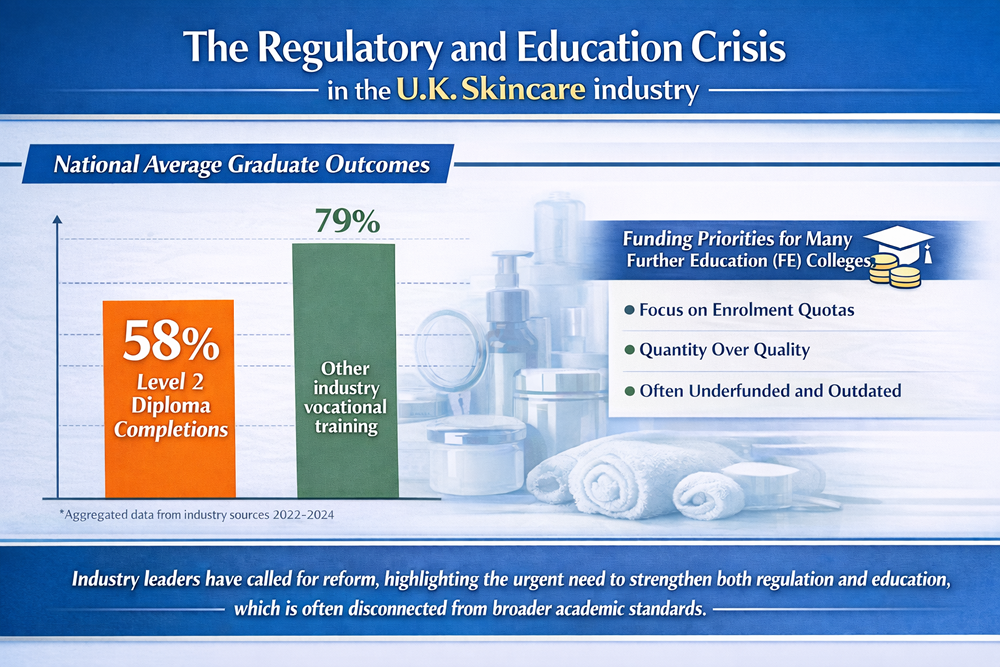
Over the last forty years, the UK beauty industry has moved away from an apprenticeship-driven sector into a multi-billion pound industry, closely connected to health, aesthetics and consumer wellbeing. [1] Despite this progress, the vocational education system that underpins the sector, particularly National Vocational Qualifications (NVQs), is facing a credibility challenge.
Increasingly, these courses are used by further education (FE) colleges to meet enrolment quotas rather than to produce well-prepared professionals. As a result, many beauty programmes are underfunded, outdated and not aligned with the requirements of modern skin health, advanced aesthetics or client safety. [2]
At the same time, the rapid growth of the aesthetics market has seen a rise in practitioners without formal training. Industry leaders have called for reform, highlighting the urgent need to strengthen both regulation and education, which is often disconnected from broader academic standards. [3]
This article explores the background of these issues and suggests ways the sector can realign with professionalism, safety and sustainable growth.
Historical Context
Before the creation of national qualifications, beauty training in the UK was largely delivered through private academies and professional organisations such as CIDESCO and BABTAC. These courses emphasised salon etiquette and practical experience but were not subject to wider academic standards.
The introduction of NVQs in the early 1990s was intended to formalise and professionalise training, offering pathways that were recognised by the UK government from Level 1 to Level 4. [5] However, this system soon faced challenges; FE colleges, influenced by funding structures, often prioritised student numbers and qualification outputs over the quality or outcome. [5] Meanwhile, the industry advanced rapidly with the advancement of skin science, clinical-grade skincare and non-invasive technologies, areas the curriculum struggled to keep abreast of.
The Regulatory Gap
Although the beauty industry makes a significant contribution to the UK economy and impacts public health, it remains one of the least regulated personal care sectors. [6] Unlike healthcare, dentistry or tattooing, where licensing and competency requirements are established, beauty therapy has no national or legal framework. With the exception of treatments involving controlled substances or lasers, practitioners do not need a formal qualification to operate.
This lack of regulation creates uncertainty for consumers, insurers, educators and employers. Qualified therapists trained to NVQ Level 2 or 3, often find themselves competing with self-taught practitioners offering high-risk procedures such as chemical peels, microneedling and injectables. In the absence of mandatory licensing, there is little motivation for ongoing professional development or adherence to consistent safety standards. While organisations including the British Beauty Council and BABTAC have campaigned for national licensing, progress has been slow.
Education & workplace misalignment
FE colleges often promote beauty therapy courses to boost enrolment rather than focusing on long-term employability. [2] This has led to an oversupply of learners, some of whom join courses without clear career intentions, viewing beauty as a fallback rather than a skilled profession.
Course content can be outdated and disconnected from current practice. Many programmes fail to cover important areas such as LED therapy, barrier repair or the science of active ingredients. [7] Employers frequently report that new graduates need further training in consultation, product knowledge and professional standards to be fit for purpose.
Inconsistent Standards and Limited Career Progression
Training quality varies widely between providers. Some colleges maintain strong industry partnerships and deliver robust programmes, while others rely on outdated syllabi with limited practical experience. [8] This inconsistency undermines confidence in qualifications.
Newly qualified therapists often enter the workplace underprepared. Many leave the sector within two years due to low pay, lack of structured career progression and limited opportunities to specialise. [9] Without clearer, regulated pathways into areas such as aesthetics or education, the industry risks losing talented professionals too early.
Pathways to Reform
For many years, licensing reform has been discussed but repeatedly pushed aside. In 2023, the UK government launched a consultation on a proposed “traffic light” regulatory system, designed to categorise treatments as low, medium or high risk and to ensure they are only carried out by appropriately qualified practitioners. [10]
Industry bodies including Habia, BABTAC, NHBF, the UK Spa Association and the British Beauty Council worked together to advise on where traditional and advanced treatments should be placed within this framework.
High-profile fatalities linked to Brazilian Butt Lifts brought mounting pressure for decisive action. In 2025, the government committed to a crackdown on high-risk treatments, marking a significant step forward. The sector now waits to see whether this momentum will extend to the regulation of medium and low risk treatments. This would help create a more consistent and safe industry for all stakeholders. [11]
A Profession at a Turning Point
The UK beauty industry stands at an important crossroads. While client demand and innovation are thriving, regulation and education have not evolved at the same pace. Without licensing, updated qualifications and clear career progression routes, the profession risks being weakened by inconsistent standards and underqualified practitioners. [5]
Meaningful reform will help safeguard clients, reinforce public confidence and ensure that beauty therapy is recognised as the skilled, professional discipline it has become.
The Role of Advanced Education in Corneotherapy
For skin therapists, an in-depth understanding of skin structure and function is essential. While NVQ’s provide foundational knowledge, they rarely prepare practitioners to manage complex barrier disorders, inflammatory conditions or compromised healing.
This is where Corneotherapy is invaluable. Focused on maintaining and restoring the stratum corneum and supporting the skin’s self-regulation, Corneotherapy equips therapists to move beyond symptom-focused treatments and adopt a root-cause approach to skin health. Without this advanced knowledge, well-meaning practitioners may unintentionally compromise the skin barrier with unsuitable treatments or ingredients.
The International Association for Corneotherapy (IAC) provides globally recognised training that helps therapists to:
• Apply an evidence-based framework to treatment planning.
• Restore skin barrier function before progressing to more advanced modalities.
• Deepen their understanding of skin physiology, corneobiology and ingredient science.
• Work ethically within their scope of practice, avoiding unsubstantiated claims or unnecessary risks.
By pursuing education in Corneotherapy, therapists strengthen their professional credibility, achieve better client results and set themselves apart in a crowded market.
In an industry where under-qualified practitioners can easily enter the field, advanced scientific training is both a professional advantage and an ethical responsibility.
References used in this article:
1. British Beauty Council. (2022). The value of beauty: Sector report. https://britishbeautycouncil.com/thevalueofbeauty
2. Professional Beauty. (2021, September 15). Schools preventing pupils from accessing vocational education. https://professionalbeauty.co.uk/site/newsdetails/schools-preventing-
pupils-from-finding-out-about-vocational-qualifications
3. Simms, J., & Gould, F. (2004). A practical guide to beauty therapy for NVQ Level 2. Nelson Thornes.
4. City & Guilds. (2024). Level 2 NVQ Beauty Therapy qualification handbook. https://www.cityandguilds.com/qualifications-and-apprenticeships/beauty-therapy
5. Department for Education. (2023). Post-16 skills plan. https://www.gov.uk/government/publications/post-16-skills-plan
6. UK Parliament. (2021). Beauty industry statistics: House of Commons Library briefing. https://researchbriefings.files.parliament.uk/documents/CDP-2021-0097/CDP-2021-0097.pdf
7. VTCT. (2023). Qualification handbook: Level 2 beauty therapy. https://www.vtct.org.uk/qualifications
8. Ofsted. (2005). Bromley College inspection report. https://dera.ioe.ac.uk/2831/2/bromley_fhe_cyc2.pdf
9. National Hair & Beauty Federation (NHBF). (2020). State of the industry survey. https://www.nhbf.co.uk/news-and-blogs/news/state-of-the-industry-report
10. British Beauty Council. (2023). Non-Surgical Cosmetic Procedures Consultation - FAQ https://britishbeautycouncil.com/non-surgical-cosmetic-procedures-consultation-faqs/
11. BABTAC. (2025). Response to government crackdown https://www.babtac.com/news/2025/08/388-response-to-government-crackdown